



Bed bugs come out at night. So if you leave the lights on when you sleep, they’ll stay hidden… right?
If only bed bug removal was so easy – we’d be out of jobs!
The lights-on theory is one of those ideas that gets passed around online as a quick fix, something to try while you figure out a proper plan. And when you’re lying in bed knowing there are insects feeding on you in the dark, any sense of control, however small, feels worth grabbing. The problem is that it doesn’t work, and relying on it can actually make things worse.
Bed bugs are not repelled by light. They are attracted to carbon dioxide, body heat, and certain chemicals in human sweat. Those signals don’t switch off when you flick a lamp on. The bugs will still find you, still feed, and still retreat to their harbourages afterwards. What light does affect is their preferred timing; bed bugs are naturally most active in the early hours because that’s when their host is most still, not because of darkness itself.
Change the lighting and they simply adjust their schedule.
Are Bed Bugs Nocturnal or Just Opportunistic?
Calling bed bugs nocturnal isn’t quite right. They’re more accurately described as negatively phototactic, which means that they prefer darkness. But that preference is almost always secondary to hunger.
A bed bug that hasn’t fed for a while won’t politely wait for the lights to go off. Studies have shown that hungry bed bugs will feed in broad daylight, in fully lit rooms, and even on people who are awake and sitting still. The trigger is proximity to a host and the chemical cues that come with it, not the ambient lighting conditions.
This is worth understanding because it reshapes how you think about the problem. Bed bugs aren’t shy creatures that can be scared off with environmental tweaks. They’re parasites that have co-evolved with humans for thousands of years, and their feeding behaviour is driven by survival, not convenience. Leaving a light on is roughly as effective as leaving the radio on. It might make you feel better, but the bugs genuinely do not care.
Can Sleeping Somewhere Else Help?
This is the other common impulse: move to the sofa, sleep in the spare room, stay at a friend’s house. It feels logical. If you’re not in the bed, they can’t bite you. But bed bugs don’t just wait patiently in the mattress hoping you’ll come back. When their primary food source disappears, they go looking for it. They’ll follow carbon dioxide trails across rooms, through hallways, and into other parts of the property. All you’ve done is spread the infestation to a second location.
Bed bugs can also survive for months without a blood meal (some studies suggest up to a year in cooler conditions) so starving them out isn’t a viable strategy either. Moving out temporarily doesn’t put any meaningful pressure on the population. It just means that when you come back, or when someone else visits, the bugs are still there, still hungry, and now potentially established in multiple rooms. The only reliable way to end the cycle is treatment that targets the bugs directly, wherever they’re hiding.
What About Other DIY Deterrents People Try?
The internet is full of suggestions: lavender oil on the sheets, tea tree spray around the bed frame, double-sided tape on the legs of the bed, dryer sheets tucked under the pillows. None of these have any scientific backing as effective bed bug deterrents. Some essential oils show mild repellent properties in laboratory conditions at high concentrations, but the gap between a petri dish result and a real bedroom is enormous.
Encasements for mattresses and pillows are sometimes recommended, and these do serve a purpose, but not the one people think. A good encasement won’t stop bed bugs from biting you; it traps any bugs already inside the mattress so they can’t escape to feed, and it makes inspection easier by eliminating a major hiding spot. It’s a useful supporting measure alongside proper treatment, not a solution on its own. The hard truth is that there is no effective DIY deterrent for an active infestation. Once bed bugs are established, you need a professional intervention that eliminates the population rather than inconveniences it.
Why Does the “Lights On” Myth Keep Spreading?
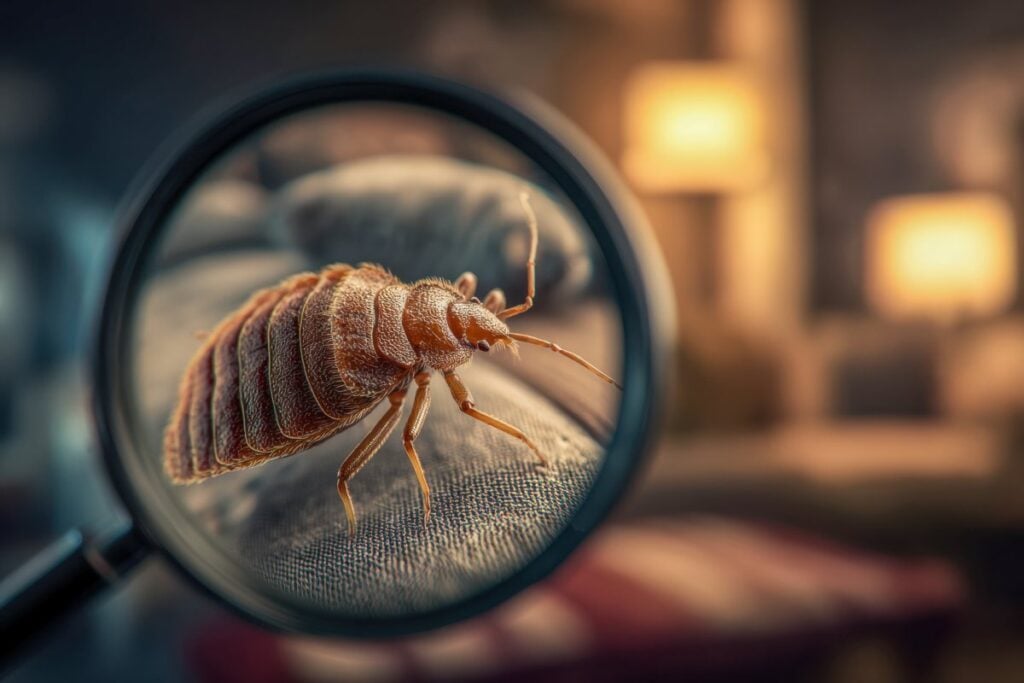
Partly because it sounds plausible, and partly because people are desperate. Bed bugs carry an enormous psychological burden. The knowledge that something is feeding on you while you sleep causes anxiety, insomnia, and genuine distress, and it’s completely rational to try anything that might offer a night’s relief. Nobody should be made to feel foolish for trying the lights trick. The issue is that it delays effective action, and every night of delay is another night the colony grows.
There’s also a general misunderstanding of what drives bed bug behaviour. People assume they operate like cockroaches, scattering when a light comes on, but the two insects have almost nothing in common behaviourally. Cockroaches are genuinely photophobic and will flee from sudden light. Bed bugs simply aren’t wired that way. Their priority hierarchy is clear: find a host, feed, return to harbourage, reproduce. Light doesn’t feature in that sequence.
What Actually Gets Rid of Bed Bugs?
Professional heat treatment is currently the most effective single-session method available. It works by raising the ambient temperature of the infested space above the thermal death point for bed bugs at every life stage, including eggs, which are notoriously resistant to chemical treatments. No pesticide resistance, no residual chemicals, and no surviving eggs waiting to hatch three weeks later. For anyone dealing with an active infestation, the most productive step is to learn about heat-based extermination for bed bugs and understand how the process works before committing to a provider.
Chemical treatments can also be effective, particularly as part of an integrated approach, but they typically require multiple visits over several weeks and rely on the bugs making direct contact with treated surfaces. Heat, by contrast, penetrates into wall cavities, furniture joints, and fabric folds where sprays can’t reach. The choice between methods depends on the property and the severity of the infestation, but what’s clear across the board is that leaving the lights on isn’t a substitute for either.
The ThermoPest Difference
At ThermoPest, we use industrial heat treatment systems that bring infested rooms to lethal temperatures for bed bugs, sustained and monitored across the entire space to eliminate cold spots where survivors could linger. Our technicians understand that bed bugs exploit every crack, fold, and cavity in a room, and so the treatment is designed to reach all of them and not just the obvious hiding places.
Beyond the technical side, at ThermoPest we recognise that dealing with bed bugs is stressful. The team provides clear guidance on how to prepare your property before treatment, explains exactly what to expect on the day, and carries out follow-up checks to confirm the infestation is fully resolved. There’s no guesswork and no hoping for the best. If you’ve been losing sleep, literally and figuratively, the solution isn’t a brighter bulb. It’s a phone call to someone who can actually fix it.