



Bed bugs are one of the most difficult household pests to eliminate quickly. The reason is not just their size or hiding behaviour, but the way their entire lifecycle is designed to survive disruption. Eggs, nymphs, and adults can all exist simultaneously in different parts of a property, often without any visible signs in the early stages.
This is why bed bug infestations rarely resolve quickly with basic DIY methods. Professional extermination works differently. Instead of targeting visible insects, it focuses on systematically removing every stage of the infestation using controlled, repeatable methods designed for complete eradication.
Understanding how professionals achieve fast elimination helps explain why results differ so significantly from consumer-level treatments.
1. Whole-Property Infestation Assessment
Professional extermination begins with understanding the true extent of the problem, rather than reacting only to visible signs.
Bed bugs rarely remain confined to a single location, so technicians assess:
- Bedrooms and sleeping areas
- Adjacent rooms and shared walls
- Furniture and soft furnishings
- Structural hiding points such as skirting boards and bed frames
This ensures treatment is based on the full infestation footprint, not just surface-level activity.
2. Identification of Active Harbourage Sites
Bed bugs do not distribute evenly throughout a property. They cluster in specific harbourage sites where conditions are ideal for hiding and feeding.
Professionals focus on identifying:
- Mattress seams and bed frames
- Upholstered furniture joints
- Electrical fittings and wall voids
- Carpet edges and concealed gaps
Locating these zones is essential for ensuring treatment reaches the core of the infestation.
3. Heat-Based Whole-Room Treatment
One of the fastest and most effective professional methods is heat treatment, which raises ambient temperature to levels lethal to all bed bug life stages.
Unlike sprays, heat:
- Penetrates furniture and structural gaps
- Reaches hidden eggs and larvae
- Treats entire rooms simultaneously
At sustained high temperatures, bed bugs cannot survive at any stage of development, which allows for rapid elimination within a single controlled treatment cycle.
Thermopest uses structured heat treatment systems specially designed to ensure consistent temperature distribution across all affected areas, reducing the risk of untreated pockets.
4. Targeted Chemical Application in High-Risk Zones
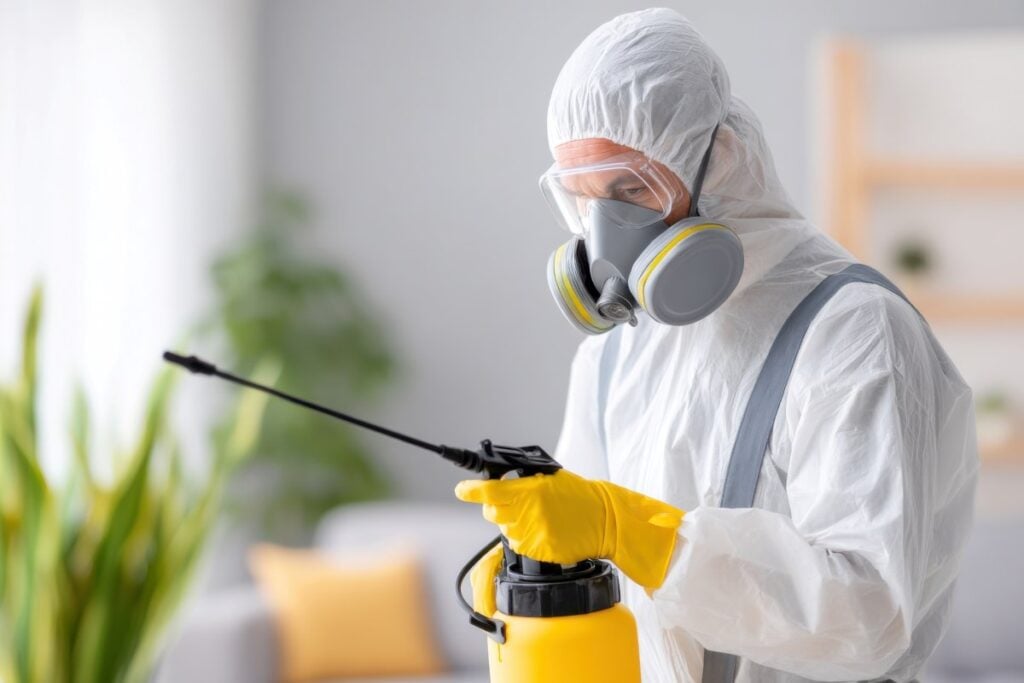
While heat is often the primary method, professionals may also use targeted chemical applications in specific scenarios.
These are applied to:
- Structural cracks and voids
- Deep furniture joints
- Hard-to-reach nesting areas
Unlike DIY sprays, professional-grade applications are carefully controlled and integrated into a broader treatment plan rather than used in isolation.
5. Vacuum Extraction of Active Populations
Mechanical removal is often used as an early intervention step to reduce live populations before or during treatment.
High-powered vacuum systems can:
- Remove visible insects from surfaces
- Reduce population density in exposed areas
- Assist in clearing heavily infested zones
While not a standalone solution, it contributes to faster overall reduction when combined with other methods.
6. Steam Treatment for Deep Fabric Penetration
Steam is used in targeted areas where heat or chemicals may not be suitable.
It is particularly effective for:
- Mattress seams
- Upholstered furniture surfaces
- Fabric-heavy environments
Steam delivers high temperatures directly into fibres, helping to destroy bed bugs in areas that are difficult to access through other means.
7. Physical Removal of Infested Materials Where Necessary
In severe infestations, some materials may be beyond salvage or too heavily contaminated to treat effectively.
Professionals may recommend:
- Removal of heavily infested mattresses
- Disposal of contaminated soft furnishings
- Isolation of non-treatable items
This prevents reinfestation from untreated reservoirs within the property.
8. Use of Monitoring and Detection Tools
Fast elimination depends on accurate confirmation that all activity has been addressed.
Professionals often use monitoring tools to:
- Track remaining activity after treatment
- Identify surviving pockets of infestation
- Confirm eradication over time
This ensures that treatment success is verified rather than assumed.
9. Follow-Up Inspection and Verification
Even after initial treatment, professionals conduct follow-up checks to ensure no residual activity remains.
These inspections focus on:
- Signs of newly hatched insects
- Remaining bite patterns or physical evidence
- Recolonisation from missed harbourage points
This step is critical for confirming full elimination rather than partial reduction.
10. Integrated Treatment Planning for Complex Infestations
The most important difference between DIY and professional extermination is not a single method, but how multiple methods are combined into a structured plan.
Integrated pest management may include:
- Heat treatment as the primary elimination method
- Chemical or steam support where needed
- Physical removal of infested materials
- Monitoring to confirm success
This layered approach ensures that no life stage or hiding location is overlooked.
Why Professionals Achieve Faster Results
Although individual DIY methods may seem faster at the point of use, they rarely deliver complete elimination. Professionals achieve faster overall resolution because they treat the entire infestation systemically.
Instead of:
- Treating visible insects repeatedly
- Waiting for eggs to hatch and reappearing
- Reacting to ongoing bites
Professional extermination focuses on:
- Eliminating all life stages in a controlled timeframe
- Addressing hidden infestation sources immediately
- Preventing reinfestation within the same cycle
This is why full resolution typically happens in days rather than weeks or months.
Speed Comes From Complete System Elimination
Fast bed bug elimination is not achieved through isolated treatments or repeated surface spraying. It comes from addressing the infestation as a complete system, including all life stages, all harbourage sites, and all potential reinfestation sources.
Professional extermination works quickly because it removes the conditions that allow bed bugs to survive in the first place. When this is done correctly, the infestation is not gradually reduced but fully resolved within a defined treatment process.
FAQs
How quickly can professionals eliminate bed bugs?
In many cases, professional treatment can eliminate bed bugs within a single treatment cycle, depending on infestation severity and property size.
Why are DIY methods slower than professional treatments?
DIY methods often fail to eliminate eggs and hidden insects, meaning the infestation continues and requires repeated treatment.
Is heat treatment faster than chemical treatment?
Yes. Heat treatment typically resolves infestations in a single session, while chemical treatments may require multiple visits over several weeks.
Do professionals treat the entire property or just one room?
Professionals usually assess the full property to ensure all infestation zones are identified and treated, as bed bugs often spread beyond visible areas.
Can bed bugs survive professional extermination?
When correctly applied, professional treatments are designed to eliminate all life stages, leaving no surviving population in the treated environment.