



Finding a cockroach in your home is an unsettling experience – and if you’ve seen one, the chances of it being the only one are slim. Cockroaches are gregarious insects that live in groups, prefer darkness, and spend most of their time hidden in harbourage sites well out of sight. The one you spotted is usually a scout from a larger population.
The good news is that cockroach infestations respond well to structured treatment when the right steps are followed in the right order. Here’s what that actually looks like.
Step 1: Identify the Species
Not all cockroaches respond to the same treatments, and misidentifying the species is one of the most common reasons DIY attempts fail. In the UK, two species account for the vast majority of infestations.
- German cockroach (Blattella germanica) – the most common in UK homes and commercial premises; small (10-15mm), light brown with two dark stripes behind the head; prefers warm, humid environments near food and water sources such as kitchens
- Oriental cockroach (Blatta orientalis) – larger (20-25mm), dark brown to black; slower moving; tolerates cooler conditions and is often found in basements, drains, and service areas
Treatment strategies, product selection, and bait placement differ between these two species. Getting the identification right before starting treatment saves significant time and money.
Step 2: Locate Harbourage Sites
Cockroaches don’t live in the open. They congregate in specific areas that offer warmth, darkness, and proximity to food and moisture. Finding these sites is essential – treatment applied anywhere else is largely wasted.
- Behind and underneath kitchen appliances, particularly refrigerators, dishwashers, and ovens where heat and moisture accumulate
- Inside wall voids and under skirting boards, particularly near plumbing
- In the motor housings of appliances – cockroaches are attracted to the warmth of running motors
- In cardboard boxes and paper goods stored in kitchens or utility areas
- Around pipework, particularly where pipes pass through walls
A torch and a thin probe (a ruler or pencil works) are useful for exploring the voids and gaps where cockroaches gather. Faecal smears – dark, irregular stains near harbourage sites – and shed skins are reliable indicators of where populations are concentrated.
Step 3: Eliminate Food and Water Sources
This step is often skipped, but it’s as important as any treatment. Cockroaches are highly adaptable survivors – remove their resources and you make treatment significantly more effective.
- Store all food, including dry goods and pet food, in sealed containers
- Clean behind and beneath appliances regularly – grease and food debris accumulate in these areas and sustain cockroach populations between treatments
- Fix any dripping taps or leaking pipes; cockroaches require water and will maintain proximity to reliable sources
- Empty bins daily and ensure bin lids seal properly
- Remove cardboard boxes and paper stacks, which provide both harbourage and food in the form of organic glue and paper
A property that’s actively sustaining a cockroach population through poor hygiene and food storage will resist treatment regardless of which products are used.
Step 4: Apply Gel Bait in Harbourage Areas
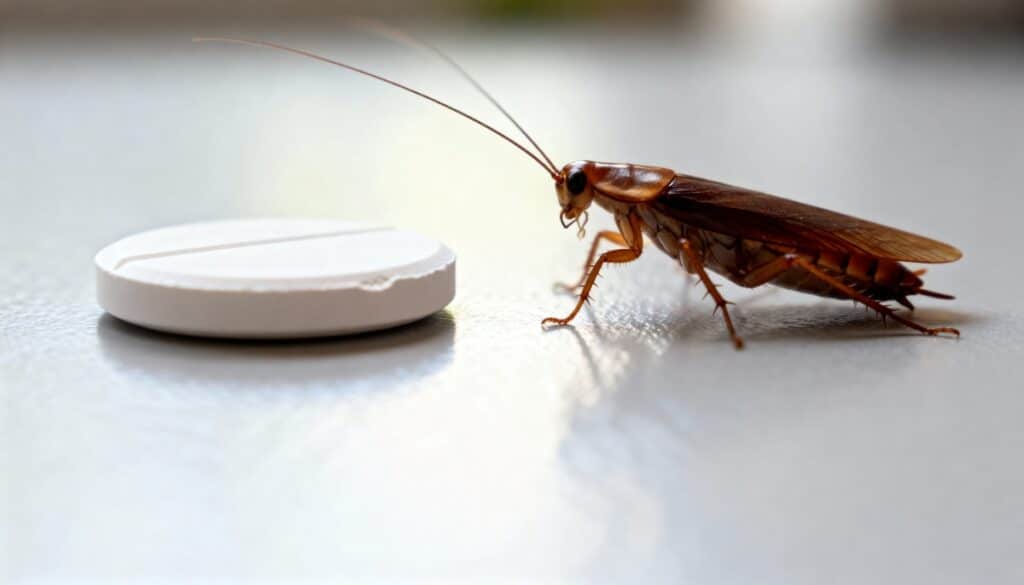
Gel bait is currently the most effective treatment available for German cockroaches, and it’s the approach professional pest controllers use. It works by exploiting cockroach feeding and social behaviour – contaminated cockroaches spread the toxin through contact and via cannibalism of dead individuals.
- Apply small pea-sized dots of gel bait in and around confirmed harbourage sites – inside appliance hinges, along the back edges of cupboards, behind kickplates
- Do not apply near cockroach-repellent products such as insecticide sprays – these will cause cockroaches to avoid the bait
- Replace bait every two to four weeks or when it becomes hard and dry
- Multiple bait placements are more effective than single large applications – cockroaches feed in small amounts from multiple sites
For Oriental cockroaches, gel bait is less effective and a combination of insecticide spray to voids and drains alongside monitoring is more appropriate.
Step 5: Apply Residual Insecticide to Voids and Entry Points
Gel bait addresses the population at harbourage sites; residual insecticide addresses movement and re-entry. Professional-grade products are significantly more effective than retail alternatives.
- Apply residual spray to wall voids, around pipe entry points, and along the routes cockroaches travel between harbourage and food sources
- Focus on cracks, crevices, and the voids beneath kitchen units – not open surfaces where cockroaches spend minimal time
- Insect growth regulators (IGRs) are a valuable addition – they prevent juvenile cockroaches from reaching reproductive maturity, breaking the breeding cycle
- Do not apply spray in the same areas as gel bait – the repellent effect will reduce bait uptake
Step 6: Monitor and Assess Progress
Treatment without monitoring gives you no way of knowing whether it’s working. Monitoring traps placed in key locations tell you where populations remain active and whether numbers are declining.
- Sticky monitoring traps placed along skirting boards and behind appliances catch cockroaches moving between harbourage and food sources
- Check traps every few days in the initial treatment period – trap counts give you a picture of population dynamics
- Reducing trap counts over two to three weeks indicate treatment is working; stable or increasing counts suggest the treatment strategy needs adjusting
- ThermoPest uses a professional monitoring approach as part of an integrated cockroach treatment programme, ensuring evidence-based progress assessment throughout
Step 7: Seal Entry Points and Prevent Reinfestation
Once the infestation is eliminated, the focus shifts to preventing re-entry. Cockroaches enter properties through gaps in masonry, around pipework, through drains, and sometimes in delivered goods.
- Seal gaps around all pipework where it passes through walls – expanding foam or silicone sealant works well for accessible gaps
- Install drain covers on floor drains and check that toilet pipe seals are intact
- Inspect incoming deliveries – particularly cardboard boxes from food suppliers or supermarkets – before bringing them into the property
- Maintain the hygiene practices established in Step 3 on an ongoing basis
Reinfestation from neighbouring properties in blocks of flats or terraced houses is also possible. In these situations, a whole-building approach coordinated with neighbours or managing agents is more effective than treating one unit in isolation.
FAQs
How long does it take to get rid of cockroaches?
With a professional integrated treatment programme, significant reduction is typically seen within one to two weeks. Full elimination usually takes two to four weeks, depending on infestation severity. German cockroach infestations have a fast reproductive cycle – a female can produce up to 400 offspring in her lifetime – so prompt and thorough treatment is important.
Can I get rid of cockroaches with just supermarket products?
For minor infestations caught very early, retail gel baits can be effective. For any established infestation, professional-grade products and expertise produce significantly better results – the active ingredient concentrations and formulations available to professionals are simply more effective than what’s available retail.
Why do I keep seeing cockroaches even after treating?
The most common reasons are incomplete identification of harbourage sites, applying repellent spray near gel bait (which prevents bait uptake), or reinfestation from an adjacent property or drain. Professional assessment can diagnose which applies in your situation.
Are cockroaches dangerous to health?
Yes. Cockroaches are associated with contamination of food surfaces with bacteria including Salmonella and E. coli. Cockroach allergens are also a documented trigger for asthma and allergic reactions, particularly in children. Treating an infestation promptly has direct health implications.
Do cockroaches come up through drains?
Oriental cockroaches in particular are commonly associated with drainage systems. They can enter properties through floor drains, toilet pipes, and service ducts. Sealing drains and maintaining pipe seals is an important prevention measure, particularly in ground-floor and basement properties.